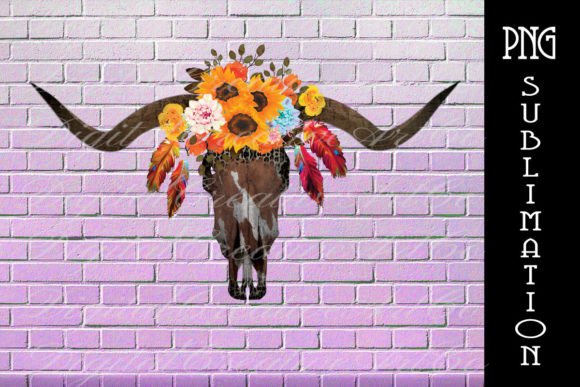
Vivid Floral Bull Skull Sublimation: A Ready-to-Use Design for Profitable Product Lines
Every small business that sells custom merchandise eventually faces the same bottleneck: finding artwork that balances visual impact with production practicality. The Vivid Floral Bull Skull Sublimation design solves that problem upfront. Instead of spending hours tweaking a graphic to fit different products, you receive a single high-resolution PNG with a transparent background, already optimized for dye sublimation and heat transfer use. This means you can move directly from download to pressing on shirts, mugs, pillows, bags, or wall art without intermediate editing steps. The 3,000×3,000 pixel resolution gives you enough detail to print clearly at typical small-to-medium product sizes, while the transparent background eliminates the need to manually remove a white box around the artwork — a common friction point in many digital design purchases.
In this article, we’ll look at where this design fits into a real production workflow, how to prepare it for different substrates, and what small decisions make the difference between a product that sells and one that returns. The focus is on practical implementation, not abstract ideas, so you can integrate this asset into your existing toolset and start creating sellable goods without guesswork.
Understanding the Digital Asset and Its Place in Your Workflow
Before pressing anything, it helps to know exactly what you’re working with. The Vivid Floral Bull Skull Sublimation file is a 3000 x 3000 pixel PNG. Because the background is transparent, the graphic floats cleanly over any substrate color — a significant advantage when you’re producing items in multiple colorways. If you were working with a JPG or a flattened graphic on a white background, you’d need to isolate the artwork, which can leave jagged edges or halos. With a transparent PNG, you simply place the design where you want it and print.
This design specifically targets the small business owner who runs a sublimation or heat transfer operation. You might be a one-person studio making to-order t-shirts, a weekend market vendor creating tumbler sets, or a print-on-demand seller building a cohesive brand identity. The bull skull motif paired with vivid floral elements has broad appeal in western, bohemian, and contemporary decor niches. That versatility means you can stretch one design across multiple product categories without diluting its impact.
Where does it fit in your process? In a typical order fulfillment sequence, the asset sits between the idea stage and the physical press. You’ve already decided on a product line. You’ve sourced blanks. Now you need artwork that can be quickly sized, printed, and transferred. This file reduces the design stage to a placement decision, letting you focus on color management, paper alignment, and heat press settings — the variables that actually affect output quality.
Preparing Your Workspace and Equipment for Consistent Results
Sublimation is more forgiving than many people think, but only if your environment and tools are ready. Start by checking that your printer is capable of handling high-resolution images with subtle gradients. The floral petals and the textured skull surface contain fine details and smooth color transitions. A printer that can’t reproduce those nuances will produce muddy prints, regardless of how good the source file is. Use a dedicated sublimation printer with appropriate ICC profiles for your ink and paper combination.
Your heat press matters just as much. Uneven pressure causes fading around the edges of mugs and can ruin the crisp edges of this design on t-shirts. Calibrate your press according to the substrate you’re using. For mugs, that often means adjusting the pressure knob until the mug wrap fits snugly but doesn’t require extreme force to close. For flat items like pillows and wall art, test the pressure distribution by pressing a sheet of carbon paper between two pieces of blank material — the imprint should be uniform.
Another preparation step many skip: moisture control. Sublimation relies on gas transfer, and any moisture in the paper or substrate can create blurring. Pre-press your substrate for a few seconds to drive out ambient humidity before you place the transfer paper. This small habit prevents the blurry halos that make an otherwise sharp design look unprofessional.
Integrating the Design into Your Product Workflow
Once your equipment is ready, the actual design integration is straightforward. Because the Vivid Floral Bull Skull Sublimation file is a transparent PNG, you can use any software that supports layered image placement — Photoshop, GIMP, Canva, or even the layout tool that ships with many sublimation printers. Set your canvas to the exact dimensions of the print area on your product, place the PNG, scale it proportionally, and position it. For a standard 11oz mug, you might size the design to around 8.5 inches wide. For a 12x12 inch pillow cover, you could keep it at full resolution and let the floral details fill the fabric.
A practical workflow tip: create a master template file for each product type. For example, a t-shirt template might include guides for the collar, sleeve edges, and a centered placement zone. Drop the transparent PNG into the template, adjust the scale, and export the print file. This template-based approach ensures consistency when you produce the same product repeatedly — a customer ordering a second shirt months later will receive an identical-looking result. It also speeds up order processing because you’re not repositioning the design from scratch each time.
Consider how the artwork interacts with the product’s shape. On a curved mug surface, a centrally placed design wraps naturally. On a flat tote bag, you might want to offset the skull slightly upward to create visual interest near the top fold. The transparent background makes it easy to test placements visually without cutting out the subject. You can move the design around on your screen and immediately see how it interacts with seams, handles, or zippers.
Ensuring Color Accuracy and Print Quality Across Substrates
Color fidelity often makes or breaks a sublimation product. The vivid floral elements demand vibrant, true-to-life output. If your prints come out dull or washed, the problem usually isn’t the design — it’s one of three things: incorrect printer settings, mismatched ICC profiles, or under-pressing. Resolve these before questioning the asset.
Start by printing a small color chart using the same ink, paper, and substrate you’ll use for the final product. Compare the printed colors to what you see on your calibrated monitor. If the reds lean orange, adjust your printer’s color management accordingly. For most home and small studio setups, using the manufacturer-recommended ICC profile for your specific paper and ink yields reliable results. Do not rely on the “vivid” or “photo” presets in your printer driver; these often oversaturate and crush detail in the darker portions of the skull.
Because this design features both delicate petals and solid bone structure, your print settings should prioritize smooth gradients. Choose a high-quality print mode that minimizes banding. If your software allows, add a subtle noise overlay to the image before printing — this can help break up faint banding artifacts that become visible on large flat areas, though it’s rarely needed with the high resolution of the source file.
Testing and Quality Control Across Substrates
No single set of press parameters works perfectly for every product. A ceramic mug holds heat differently than a polyester shirt, and a polyester-blend pillow cover behaves differently than a 100% polyester fabric. Before running a full batch, invest time in substrate-specific testing using the Vivid Floral Bull Skull Sublimation design as your test image. It contains fine lines, complex color ranges, and large tonal areas — an ideal diagnostic pattern.
For a ceramic mug, a typical starting point is 400°F for 180 seconds with medium pressure. But your specific mug wrap thickness and press model may shift that. Press one mug, let it cool completely, and inspect: Are the white areas of the skull clean, or is there a yellowish tint? Yellowing means over-pressing; reduce time or temperature slightly. Are the dark floral outlines sharp? If they seem fuzzy, check for movement during pressing or excessive moisture.
For fabric items like t-shirts, bags, and pillow covers, the process changes. Use a protective sheet between the press platen and the item to prevent ghosting. After pressing, peel the paper while hot — this often produces sharper lines on fabric. Then, examine the print from an angle. If the colors appear to sit on top of the fabric rather than within it, the temperature might be too low or the pressure insufficient. The design should feel like part of the material, not a plastic coating.
Document these tests. A simple spreadsheet recording substrate type, press temperature, time, pressure, and result prevents you from relearning the same settings six months later. When a repeat customer orders, you can pull up the exact parameters and replicate the product with confidence.
Scaling Production Without Losing Consistency
Once your testing is complete, the design becomes a dependable revenue generator. The Vivid Floral Bull Skull Sublimation file supports batch production because it requires no editing between runs. You can queue up dozens of prints from the same high-resolution master, and each one will be identical, provided your printer doesn’t run low on ink mid-batch. This predictability is what allows a small operation to scale from ten orders a week to fifty without a proportional increase in rework or customer complaints.
Batch processing still demands quality checks. Randomly pull one item from every ten you press and compare it against your reference sample. Look for shifts in color density — fading across a large batch can signal a declining ink level or a print head that needs cleaning. The design’s complex floral patterns will reveal subtle inconsistencies faster than a simple geometric print would. If the petals start losing their vibrancy at the edges, stop the run and address the printer.
Another scaling consideration: store your print files in a way that prevents accidental resolution loss. Always keep the original 3000×3000 pixel PNG intact. When you create product-specific versions, save them as high-quality PDFs or PNGs with no additional compression. Resaving a JPEG multiple times introduces artifacts that degrade the design over repeated production cycles.
Long-Term File Management and Brand Building
Owning a high-quality digital asset like this isn’t a one-time transaction — it’s an investment in your product catalog. Organize your files so that you can retrieve the Vivid Floral Bull Skull Sublimation design instantly when a new product opportunity arises. Keep a master folder with subfolders for “Original Files,” “Product Templates,” and “Production Ready Exports.” This simple structure saves hours of searching later.
Consider how the design can strengthen your brand identity across multiple online platforms. Use the graphic in social media previews, product listing photos, and even packaging inserts. Because the transparent background integrates so cleanly with different contexts, you can overlay the skull onto lifestyle images without obvious cut-and-paste artifacts. Consistent use of the same artwork builds recognition — a customer who bought a pillow might recognize the motif on a bag and be more likely to purchase again.
Finally, think about future product expansions. This design works well beyond the typical t-shirt and mug combination. Experiment with sublimation-ready hardboard panels for wall art, aluminum sheets for glossy metal prints, or even neoprene can coolers. Each new product application leverages the same digital file you already own, increasing your return on investment. Since you’re not paying for additional licensing or artwork modifications, the marginal cost of adding a new sku is just the blank and your time — a low-risk way to test market demand.
In practice, what separates a profitable custom product line from a frustrating one is rarely the design itself, but how you implement it. The Vivid Floral Bull Skull Sublimation file gives you a technically sound starting point: transparent background, print-ready resolution, and a motif with proven aesthetic appeal. Your role is to take that asset through a disciplined workflow — preparation, placement, color management, testing, and consistent production — until the printed result matches the intended vision. When the process becomes repeatable, the design becomes a reliable piece of your business, not just another file on a hard drive.