Watercolor Peony Floral Clipart Graphic: A Versatile Design Resource for Today's Creators
The appeal of a Watercolor Peony Floral Clipart Graphic goes far beyond its surface beauty. At a moment when digital creators, small business owners, and marketing professionals are all searching for ways to add warmth and authenticity to their visual output, watercolor floral elements have become something of a quiet powerhouse. They bridge the gap between handcrafted charm and digital efficiency, offering the best of both worlds without demanding hours of illustration work from scratch. What makes this particular resource noteworthy is how it packages botanical elegance into formats that adapt to real workflows, not just idealized ones.
For anyone who has ever tried to source quality floral graphics, the frustration is familiar. Stock libraries can feel sterile. Hiring an illustrator for every project adds up quickly. And free resources often come with licensing headaches or inconsistent quality. A thoughtfully assembled set of rose and peony watercolor elements sidesteps all of that by giving you a cohesive visual language in a single download. The result is faster project turnaround, a more polished final product, and creative flexibility that generic templates rarely provide.
What Defines a High-Quality Watercolor Floral Clipart Set
Not all floral clipart is created equal, and the differences become obvious the moment you zoom in on a file. A Watercolor Peony Floral Clipart Graphic that holds up under scrutiny will feature soft, natural color transitions, organic petal edges that mimic real brushwork, and transparent backgrounds that integrate seamlessly into layouts. The best sets avoid the plastic, over-saturated look that plagued early digital floral graphics and instead lean into the subtle imperfections that make watercolor feel alive—gentle pigment blooms, slight variations in opacity, and delicate washes that suggest movement rather than rigid structure.
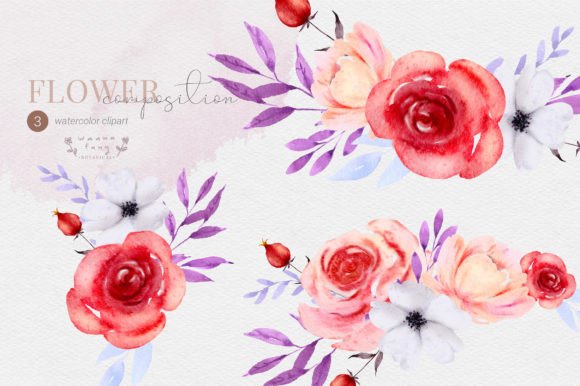
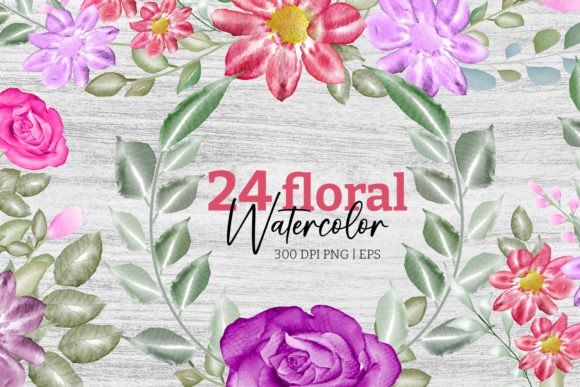
This particular collection of rose floral watercolor elements exemplifies that approach. It brings together red roses for bold, passionate statements, pink roses for romance and softness, and white roses for understated sophistication. The variety isn't just decorative; it serves a functional purpose. A single project might need the dramatic weight of a deep crimson bloom for a hero image, then shift to airy pink accents for secondary details. Having those tonal options within one cohesive set means you aren't cobbling together mismatched elements from different sources, which almost always shows in the final composition.
The inclusion of supporting botanical elements elevates the set further. Beyond the focal roses, you get complementary floral and leaf arrangements that fill out compositions naturally. Foliage in watercolor style—soft sage greens, muted olive tones, and wispy stems—provides the structural breathing room that makes floral designs feel complete rather than cluttered. It is a principle that experienced designers understand intuitively: flowers need greenery to ground them, and the ratio between the two determines whether a piece reads as intentional or haphazard.
File Formats That Actually Work for Modern Projects
One of the most practical aspects of this design resource is the file format selection. The set includes EPS files—fully editable vector formats that can scale to any size without losing quality. For print designers working on large-format projects like signage, fabric patterns, or packaging, vector capability isn't a luxury; it is a necessity. Raster images simply fall apart when enlarged beyond their native resolution, but an EPS file lets you resize a peony graphic to billboard dimensions and still retain every delicate petal detail.
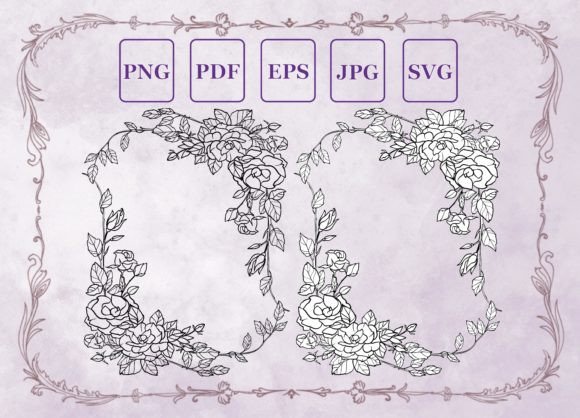
The PNG files in the collection serve a different but equally important purpose. With their built-in transparency, PNGs slot directly into digital designs—social media graphics, website headers, email newsletters, digital invitations—without requiring any background removal work. The set provides a generous selection: six dedicated rose flower PNGs, eight floral and leaf element PNGs, four floral frame PNGs, and two abstract watercolor background PNGs. That breakdown matters because it means you aren't stuck with just isolated flowers. The frames give you ready-made containers for text or photography, while the abstract backgrounds provide atmospheric underpaintings that tie compositions together.
The abstract watercolor backgrounds deserve special mention. They offer the kind of organic texture that flat color fields cannot replicate—subtle pigment washes, gentle color gradients, and the irregular edges that signal something was made by hand. Layering floral elements over these backgrounds creates depth that feels dimensional rather than flatly digital. For designers working in wedding stationery, branding, or editorial layout, that textural quality is often the difference between a design that looks templated and one that feels custom.
Practical Applications Across Industries and Projects
The versatility of rose and peony watercolor clipart becomes apparent when you examine the range of projects it supports. Wedding and event stationers use these elements for invitation suites, place cards, menu designs, and thank-you notes. The romantic quality of watercolor roses aligns naturally with bridal aesthetics, and having matching frames and backgrounds means an entire stationery set can maintain visual coherence from the save-the-date card through to the day-of program.
Small business owners, particularly those in beauty, wellness, and lifestyle niches, find floral watercolor elements invaluable for branding. A logo mark featuring a simplified peony silhouette, social media templates accented with rose corner flourishes, product packaging that carries a botanical motif across labels and tags—these applications build a recognizable brand identity without requiring a full custom illustration budget. The editable vector files make it possible to recolor elements to match specific brand palettes, extending the usefulness of the same clipart set across an entire visual identity system.
Bloggers and content creators use these graphics to elevate digital products like e-books, printable planners, and course materials. A cover page with a thoughtfully placed watercolor peony arrangement signals quality before a reader even engages with the content. In an environment where audience attention is scarce and first impressions are formed in seconds, visual polish carries disproportionate weight. The same principle applies to email marketing, where floral headers and decorative dividers can increase engagement simply by making communications feel more personal and less automated.
Educators and workshop facilitators have also discovered the value of floral clipart for creating warm, inviting classroom materials. Worksheets, certificates, and presentation slides benefit from botanical accents that soften what might otherwise feel like rigid instructional documents. The psychological effect is real—people respond to visual beauty, and learning materials that incorporate natural imagery tend to feel more approachable.
Why Watercolor Florals Continue to Resonate in Design
The sustained popularity of watercolor florals in commercial design isn't accidental. It reflects a broader cultural preference for authenticity and craftsmanship in an increasingly automated visual landscape. As artificial intelligence generates more content and templated design becomes ubiquitous, the organic irregularity of watercolor stands out. Consumers have developed a sophisticated eye for what feels mass-produced versus what appears thoughtfully crafted, and botanical watercolor elements consistently signal the latter.
There is also a practical reason behind the trend: watercolor florals are remarkably forgiving in composition. Unlike geometric patterns or minimalist graphics that demand precise alignment, floral arrangements thrive on organic placement. A rose clipart graphic can be rotated, scaled, and positioned with intuitive freedom, and slight overlaps or asymmetrical groupings often enhance the natural feel rather than detract from it. For creators who aren't formally trained in design, this margin for experimentation reduces the barrier to producing professional-looking results.
The color psychology of roses and peonies further explains their enduring appeal across market segments. Red conveys passion and boldness, pink suggests tenderness and approachability, and white communicates purity and simplicity. A single floral clipart set that spans that emotional range gives designers the vocabulary to match imagery to message without hunting through disparate sources. Combined with soft watercolor rendering, these classic flower meanings feel contemporary rather than dated.
Integrating Clipart Into Efficient Creative Workflows
Experienced designers know that the true value of a clipart resource is measured in workflow efficiency. A Watercolor Peony Floral Clipart Graphic set that includes multiple file types, pre-isolated elements, and coordinating backgrounds eliminates hours of asset preparation. Instead of clipping paths, removing backgrounds, or adjusting mismatched color temperatures across different source images, you can drag, position, and refine. The time saved compounds across projects, making the initial investment in a quality set pay for itself through increased output capacity.
The editable vector format opens additional workflow possibilities. Designers working in Adobe Illustrator or Affinity Designer can deconstruct EPS files, extract individual petals or leaf clusters, and reassemble them into entirely new floral arrangements. This extends the usable life of the clipart far beyond its original configurations. A set that ships with four floral frames, for example, might yield dozens of custom variations once you start combining elements, adjusting scale relationships, and experimenting with color substitutions.
For teams and collaborative projects, having a unified clipart library simplifies handoffs and maintains consistency. When multiple people are producing social media graphics, marketing collateral, and product imagery, shared access to the same watercolor floral elements ensures that the brand's botanical aesthetic doesn't drift. Marketing managers who have struggled with maintaining visual cohesion across freelancers and internal team members will recognize the operational value immediately.
Selecting and Using Floral Elements With Intention
Thoughtful application separates effective floral design from decorative clutter. The most successful projects using peony and rose clipart tend to follow a few observable principles. First, they use flowers as focal points or framing devices rather than distributing them evenly across a composition. A single well-placed rose cluster carries more visual weight than a dozen scattered blooms because the eye needs a clear entry point. Second, they balance floral density with negative space—areas of breathing room that prevent the design from feeling suffocated. White space is a design element in its own right, and watercolor florals work best when they are given room to breathe.
The abstract watercolor backgrounds in this particular set are especially useful for establishing atmosphere without competing with foreground elements. A soft wash of color behind a floral frame creates depth, while a more textured background can serve as the foundation for layered compositions that include typography, photography, and botanical accents. The free font included with the set adds another layer of cohesion—typography that complements the organic quality of watercolor rather than clashing with it.
Color harmony across all elements is another consideration. The rose watercolor elements in this collection share a consistent palette and rendering style, which means they can be mixed freely without visual discord. A composition that combines a red rose focal point, pink rose accents, white rose highlights, and leafy flourishes from the supplementary elements will feel like a single artistic vision rather than an assembly of disparate parts. That level of internal consistency is what distinguishes a curated clipart set from a random image collection.
The Realistic Value for Creators and Businesses
For entrepreneurs and freelancers managing tight budgets, the economics of clipart resources make sense. Commissioning a single custom watercolor illustration can cost anywhere from fifty to several hundred dollars depending on the artist and complexity. A comprehensive floral clipart set, by contrast, provides dozens of elements at a fraction of that cost and can be reused across unlimited projects. The licensing typically covers commercial use, which means the graphics can appear on products for sale, client work, and promotional materials without recurring fees.
The learning curve is also minimal. Unlike advanced illustration software that takes months to master, using pre-made PNG and EPS files requires only basic familiarity with common design tools. Small business owners who handle their own marketing can produce polished graphics within hours of downloading the files. That accessibility aligns with broader industry shifts toward empowering non-designers to create professional visuals—a trend driven by platforms like Canva, where watercolor clipart is frequently integrated into user-friendly templates.
Quality remains the differentiator. The watercolor effect is notoriously difficult to simulate convincingly in digital form. Low-quality floral graphics betray themselves through harsh edges, flat color fills, and an absence of the translucent layering that defines real watercolor painting. This set of rose floral watercolor elements, with its editable vector files and high-resolution PNGs, preserves the delicate pigment behavior that makes botanical watercolor so appealing in the first place. For creators who care about the integrity of their visual output, that fidelity is non-negotiable.
The inclusion of floral frames is another practical feature that expands the utility of the set far beyond simple flower placement. Frames built from roses and foliage provide natural containers for text, logos, or photography—turning a standard rectangular composition into something that feels bespoke. Whether used for certificate borders, invitation trims, social media quote graphics, or product label designs, these frames do the heavy compositional lifting and leave the creator free to focus on messaging and layout.
Moving Forward With Botanical Design Elements
As visual culture continues to evolve, the appetite for authentic, nature-inspired imagery shows no sign of fading. The enduring presence of floral motifs across centuries of art and design suggests that botanical elements are not a passing trend but a fundamental visual language that adapts to each era's aesthetic sensibilities. Watercolor peony and rose clipart represents this generation's expression of that timeless impulse—digital in delivery, organic in feel, and infinitely adaptable to the needs of creators working across mediums.
What matters most is how these resources are put to use. A designer who treats floral clipart as thoughtful design material rather than decorative filler will produce work that resonates. The set described here—with its red, pink, and white roses, its leafy accents, its frames and backgrounds, and its flexible file formats—provides the raw ingredients. The rest comes down to creative vision, compositional judgment, and an understanding of the audience you are designing for. Those who combine quality assets with intentional execution will continue to produce the kind of work that stops a scroll, earns a second look, and leaves a lasting impression.